Glow Journal › Glass Skin
Glass SkinIs PDRN Really “Salmon Sperm” Skincare?

Is PDRN Really "Salmon Sperm" Skincare?
"Salmon sperm skincare" might be one of the strangest phrases to enter the beauty world.
It is also one of the most misunderstood.
PDRN — short for polydeoxyribonucleotide — is a DNA-derived ingredient increasingly appearing in skincare and aesthetic medicine. Traditionally, PDRN has been produced from highly purified DNA obtained from the reproductive cells of salmonid fish. That origin is where the viral nickname "salmon sperm skincare" comes from.
But no, that does not mean a PDRN serum is simply raw salmon sperm in a bottle.
The source material undergoes processing and purification to isolate DNA-derived fragments. And that distinction matters, because underneath the provocative nickname is a much more useful question:
What can PDRN actually do when you put it on your skin?
That is where the science becomes more nuanced.
What Exactly Is PDRN?
PDRN stands for polydeoxyribonucleotide.
In simple terms, DNA is made from building blocks called nucleotides. PDRN preparations contain chains or fragments of this DNA-derived material.
Traditional PDRN has commonly been sourced from salmonid reproductive cells, although research is also exploring alternative sources.
PDRN has a research history that extends beyond today's beauty trend, including medical and aesthetic applications. But there is an important catch:
A medical or injectable PDRN treatment and a cosmetic PDRN serum are not automatically equivalent.
So, Is PDRN Really Salmon Sperm?
Traditional salmon-derived PDRN can originate from purified DNA obtained from salmonid sperm cells, but calling the finished cosmetic ingredient simply "salmon sperm" leaves out the purification and processing involved.
That is the short answer.
The viral nickname describes the ingredient's source in a sensational way, but the finished cosmetic ingredient is a processed DNA-derived material — not raw reproductive material.
Why Is Everyone Suddenly Talking About PDRN?
Part of PDRN's popularity comes from the intersection of K-beauty, aesthetic medicine and social media.
Treatments involving polynucleotides and PDRN have attracted growing attention in aesthetics, while the unforgettable "salmon sperm" nickname made the ingredient especially easy to spread online.
As PDRN moved from aesthetic procedures into topical serums, creams and masks, another question became much more important:
Can PDRN actually work when applied topically?
Topical PDRN Is Not the Same as Injectable PDRN
This is one of the most important distinctions in the entire conversation.
An injected ingredient bypasses the outer skin barrier. A topical cosmetic does not.
PDRN molecules can be relatively large, so topical delivery depends heavily on factors such as molecular size, formulation and delivery technology.
That means research involving injected PDRN should not automatically be used as proof that every topical PDRN serum will produce the same effects.
Topical research is evolving, but the results of one specific formulation should not be generalized to every product containing PDRN.
What Does Topical PDRN Actually Do?
The safest way to describe topical PDRN today is as an emerging cosmetic ingredient whose topical evidence is still developing.
Research into PDRN and related polynucleotides has explored skin-recovery, signaling and extracellular-matrix pathways, but much of the historical evidence comes from medical, injectable, laboratory or procedural settings.
For topical skincare, formulation matters.
Rather than treating a PDRN serum like a cosmetic version of an injection, it is more reasonable to see it as an ingredient being explored for supporting the appearance of healthy-looking, resilient and radiant skin.
What Is Hyaluronic Acid?
While PDRN is generating curiosity, hyaluronic acid is already one of skincare's most familiar hydration ingredients.
Hyaluronic acid is valued in topical skincare because it helps bind water and support hydration. For a deeper look at how hydration ingredients support skin texture and radiance, see How to Improve Skin Texture.
In a skincare routine, that can help skin look:
- more hydrated
- smoother
- plumper
- more supple
Why Pair PDRN With Hyaluronic Acid?
This is where the pairing becomes interesting.
PDRN brings the emerging ingredient story.
Hyaluronic acid brings hydration.
They do not need to be described as a medically proven "miracle combination" to make sense together in a cosmetic routine.
A hydration-focused routine can use one product to introduce PDRN and another to support moisture and skin comfort. For a broader look at building a routine around hydration and radiance, see What Is Glass Skin? — a K-beauty concept that puts hydration at the center of everything.
Can You Use PDRN and Hyaluronic Acid Together?
Yes, they can generally be incorporated into the same cosmetic skincare routine.
They serve different roles, which is why the pairing can make sense.
Which Goes First: PDRN or Hyaluronic Acid?
There is no universal rule based only on the ingredient names.
The actual texture and formulation of the products matter.
A simple routine may look like:
Cleanser → Renewal Elixir → Dew Quench Serum → Moisturizer → SPF in the morning
depending on how the individual products layer on your skin.
Where MÉLARE Fits Into the PDRN Conversation
At MÉLARE, we are interested in skincare trends — but we are even more interested in understanding what is behind them.
That is why we do not present PDRN as a miracle.
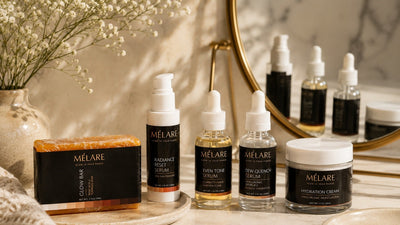
MÉLARE Renewal Elixir features PDRN in a formula designed to complement a hydration- and radiance-focused skincare routine.
MÉLARE Dew Quench Serum features a hyaluronic complex designed to support hydrated, plump-looking skin.
Together, they offer a simple way to explore a PDRN + hyaluronic acid routine without making skincare unnecessarily complicated. If you are new to building a routine from scratch, Stop Buying Skincare Products. Start Building a Skincare Routine. is a good place to start.
Ready to Explore PDRN + Hyaluronic Acid?
Discover the MÉLARE hydration pairing:
Shop MÉLARE Dew Quench Serum →
Can You Use PDRN Every Day?
That depends on the individual product and its directions.
If a cosmetic PDRN product is formulated for daily use, it may be used according to its instructions. If your skin is sensitive, introducing new products gradually is always reasonable.
Can PDRN Be Used With Niacinamide?
There is no general rule saying PDRN and niacinamide cannot appear in the same cosmetic routine.
The bigger consideration is the full formulation and how many active products your skin is tolerating at once. For more on niacinamide and how it works in a routine, see What Is Niacinamide?
What About Vitamin C?
Again, formulation matters.
If combining multiple products causes persistent burning, stinging, redness or irritation, simplify the routine rather than assuming irritation means the products are "working harder."
Is PDRN Good for Sensitive Skin?
Seeing "PDRN" on an ingredient list does not automatically tell you whether the whole formula is appropriate for sensitive skin.
Fragrance, preservatives, supporting actives and the overall formulation all matter.
Patch testing and gradual introduction are sensible for reactive skin.
What If You Have a Fish Allergy?
Because traditional PDRN may be derived from salmonid sources, anyone with a known fish allergy should verify the source of the specific product and discuss concerns with an appropriate healthcare professional before use.
Do not assume every PDRN product uses the same source.
PDRN vs. Polynucleotides: Are They the Same Thing?
Not exactly, although the terms are sometimes used loosely.
PDRN and polynucleotides are both DNA-derived materials, but they can differ in molecular characteristics and how they are prepared.
For consumers, the practical takeaway is simple:
Do not assume every "PDRN," "polynucleotide," or "salmon DNA" product is identical.
Source, molecular size, concentration and formulation can all matter.
Frequently Asked Questions
Is PDRN really salmon sperm?
Traditional fish-derived PDRN may be made from purified DNA obtained from salmonid sperm cells. The finished ingredient is processed and purified DNA-derived material, which is why calling the final cosmetic product simply "salmon sperm" is misleading.
What does PDRN stand for?
PDRN stands for polydeoxyribonucleotide.
What is "salmon sperm skincare"?
It is a viral nickname for skincare containing salmon-derived PDRN or related DNA-derived ingredients.
Is topical PDRN the same as injectable PDRN?
No. Injectable PDRN bypasses the skin barrier, while topical PDRN must be delivered through a cosmetic formulation. Evidence from injections should not automatically be applied to topical products.
Does topical PDRN actually work?
Research is emerging, but results depend heavily on formulation, molecular characteristics and delivery. One product's research should not automatically be generalized to every PDRN serum.
Can PDRN and hyaluronic acid be used together?
Generally, yes. They can serve complementary roles in a cosmetic routine, with hyaluronic acid primarily supporting hydration.
Which goes first, PDRN or hyaluronic acid?
Follow the directions for the specific products. In many routines, texture and formulation are more useful guides than the ingredient names alone.
Can I use PDRN every day?
Follow the directions of the particular PDRN product. If your skin is sensitive, gradual introduction is sensible.
Is PDRN vegan?
Traditional salmon-derived PDRN is not vegan. Always verify the source used in the specific product.
Is PDRN just another skincare fad?
It is more complicated than that. PDRN has a research history that predates its current beauty popularity, but the evidence for topical cosmetics is still developing.
The Bottom Line
PDRN may have reached social media under the unforgettable nickname "salmon sperm skincare," but the science deserves a better explanation than the nickname provides.
Traditional PDRN can originate from purified salmonid reproductive-cell DNA. It has a longer history in medical and aesthetic research, while evidence surrounding topical cosmetic PDRN is still evolving.
The most useful way to think about it is not as a miracle ingredient, but as an emerging skincare ingredient whose performance depends on source, formulation, molecular characteristics and delivery.
Paired thoughtfully with a hydration ingredient such as hyaluronic acid, PDRN can fit into a modern hydration- and radiance-focused skincare routine without the hype.
This article is for general educational purposes and does not replace personalized medical advice.